
Disclaimer: As I begin to write this post, I can’t help but think about the folks I just can’t seem to forgive. On the surface, I suppose that makes me a hypocrite for writing an article about forgiveness. Rather than give in to the feeling of guilt and write about something else, I’m going to lean in. Besides, if you really know me, you already know that I’m usually writing to myself more than I’m writing to anyone else.
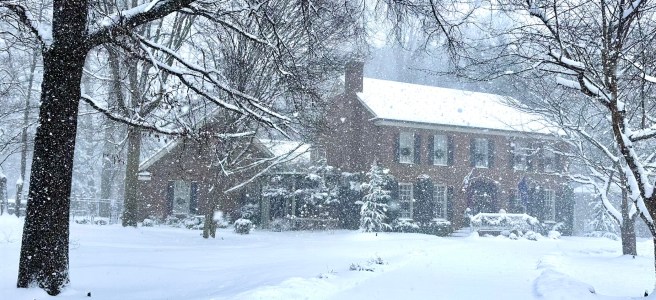
Yesterday, 14.5″ of snow fell at our house. From the moment Kasey and I woke up until after we went to sleep, big beautiful snowflakes fell from the sky and blanketed everything in a soft, pillowy sheet of white powder. More snow fell than I can ever personally recall experiencing in a day, which includes going back to my youth in New Jersey. In fact, Kasey brought a special chair downstairs and sat watching the snow fall peacefully into our backyard. That’s when I first got the idea for this message.
As I checked the snowfall maps this morning, which showed Kannapolis as having among the highest total snowfall in the state, I think it’s safe to say that just about everyone reading this has recently experienced some measure of snowy magic.
You see, freshly fallen snow has a way of covering all the imperfections that exist as we look out onto the various landscapes that surround us. Rocky mountaintops, bare spots in the grass, ruts on the roadside, and homes that need new roofs are all painted in a soft layer of white crystals and, if you’re like me, seem to become much more beautiful with each passing moment and each flake that lands softly in its perfect place.
Like the snow, forgiveness has a way of setting things right. In fact, without forgiveness, broken relationships will never mend.
Some of you might find it odd that I’m writing about forgiveness. You might be thinking, This is a leadership series; why on earth is he talking about forgiveness? I suppose, depending on your perspective, that’s a fair point. Despite that, I’d offer a question in return: When have you ever encountered a leader who didn’t need to ask for forgiveness or offer it when requested? As for the first part of that question, if you know of such a leader, please let me know; I’d very much like to meet them!
Of course, leaders must be well-versed in the “heart” of forgiveness. Notice, I called it the “heart” because it’s more than an art, and it’s definitely not a science. Beyond this, forgiveness, or refusing to give it, usually isn’t rooted in the mind or in logic. In many cases, it makes sense to forgive far earlier than we do. And yet, we usually don’t. Oftentimes, we wait much longer than we should and, in the worst cases, we miss our chance altogether.
Let me be clear about something: The quicker we forgive, the quicker we can get back to leading well. Like snow, forgiveness does not say the imperfections were never there, but it covers them nonetheless. While forgiveness does not rewrite the past or excuse the harm, it allows us to take the next step toward healing, toward clarity, and toward making new meaning, not just for ourselves, but sometimes for our entire organization.
Again, some of you might be thinking, No need to make a big deal out of things. Time heals all wounds. Again, I won’t argue with you too much, other than to make this observation: If nothing changes, time is more likely to harden our resolve. Forgiveness, offered freely, softens what time never can.
Greatness, I would argue, is choosing to forgive sooner than feels comfortable – especially when it’s close, especially when it’s big, especially when someone doesn’t deserve it. At least, that’s what I’m still learning. If you’re honest with yourself, it might be what you’re learning, too.
#ChooseToBeGreat
Angelo

 CHOOSE TO BE GREAT