“Leadership is the capacity to translate vision into reality.”
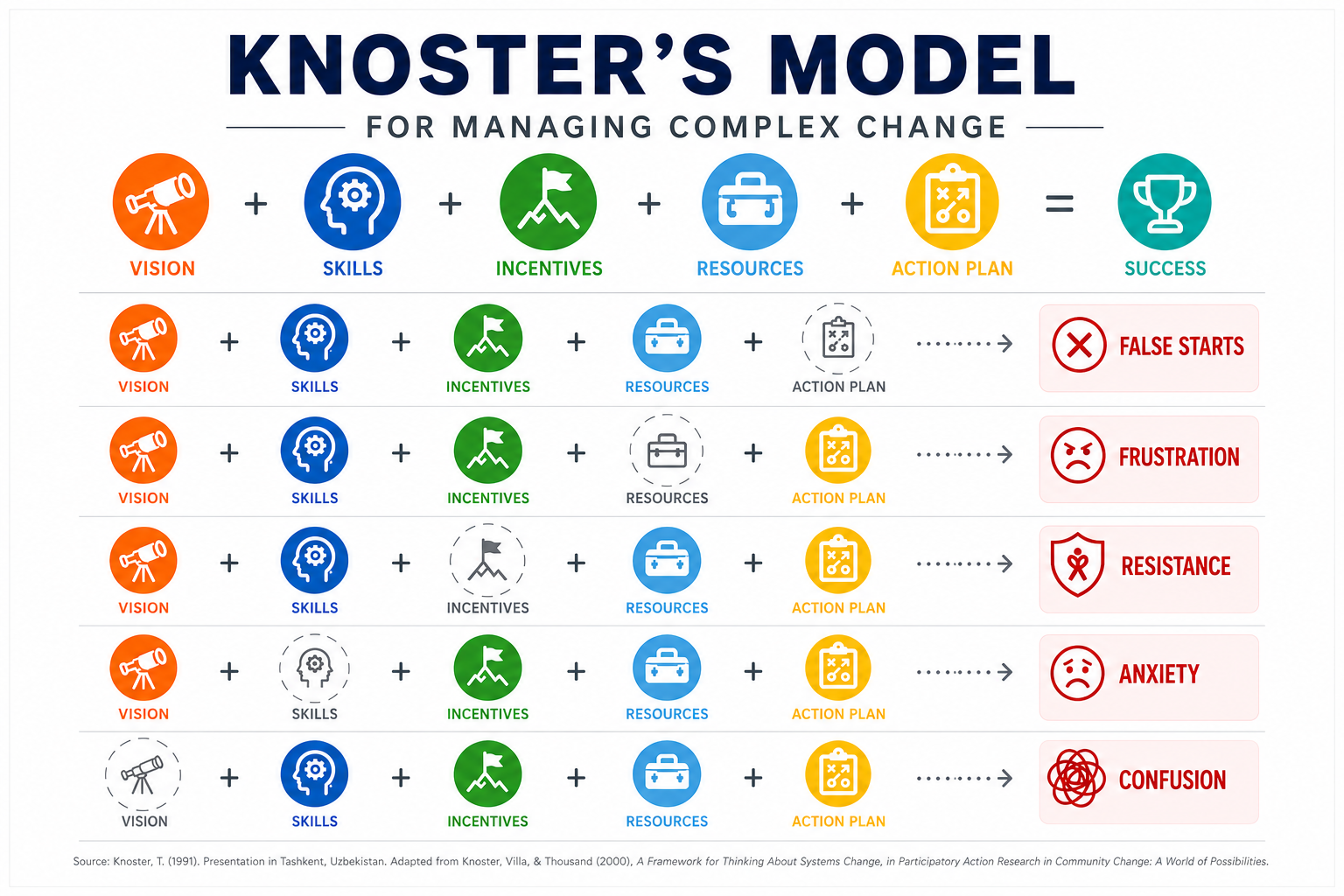
While Warren Bennis wrote those words, it wasn’t the quote I kept on my desk as a Principal. Rather, it was Knoster’s Model for Managing Complex Change (1991). As you’ll see, it’s not just a framework for understanding change, but a diagnostic tool for leading it.
Note: I created the graphic below with the assistance of ChatGPT. The graphics associated with the Model were outdated, and I wanted to produce a visual for today’s leaders.
About the same time I was introduced to this model, I had the privilege of listening to Dr. John Landis speak at an EdCamp I coordinated for our school district. At the time, he was a National Development Executive with Apple. During his introduction, he spoke illustratively about the rate at which all human knowledge doubles. Prior to 1900, human knowledge doubled about every century. After World War II, it was doubling about every 25 years. By the 1980s, the totality of human knowledge was doubling about every year. Today, some people would argue that it’s doubling every 13 hours, though there is no truly reliable way to quantify this at the moment. The point, however, remains powerful:
The dynamic nature of our world is accelerating. We can barely keep up with it.
Returning to Knoster’s Model, I kept a copy on my desk for five years as a Principal. Not in a drawer. Not in a notebook. Taped to the wall right next to my desk so I could see it every single day. As leaders, we can count on at least one thing: Change will happen, and it will happen fast. Education, though it lags, is not spared this truth.
Schools are never not changing. Which means leaders are always managing change. It’s not something we must prepare for occasionally; it’s the environment in which we live. We are leading in constant, iterative states of adjustment and response.
Leading change is leadership.
Right now, schools everywhere have already begun to think about next year. They’re sketching up plans for this summer and adjusting based on many competing priorities (and realities). High school Principals are tweaking master schedules, district leaders are naming next year’s initiatives in Principal meetings, and everyone is trying to figure out what stays and what shifts.
Knoster’s Model reminds us that change – successful change – almost never happens by accident. It requires five things to work together:
- Vision – A clear and shared understanding of what the future should look like and why the change matters.
- Skills – The knowledge, training, and support people need to implement the change successfully.
- Incentives – Meaningful reasons that make the change worthwhile and motivate people to engage.
- Resources – The time, tools, structures, and supports necessary to make change happen.
- Action Plan – A concrete set of steps that turns intention into structured implementation.
If we miss one of these things as we attempt to enact change, something predictable happens:
- Without an Action Plan, we get false starts.
- Without Resources, frustration sets in.
- Without Incentives, resistance mounts.
- Without Skills, anxiety increases.
- Without Vision, people experience confusion.
I didn’t keep this model on my desk simply because it was a clever way to view change management. I kept it there because it helped me identify what was missing every time something wasn’t going the way we wanted it to go. More often than not, I could trace the problem back to one of those missing pieces.
As you think about your plans for next year and beyond, I think it’s worth asking yourself: Are any of these missing from our plans? If so, it’s our job – your job – as leaders to find them and build them into the plan.
If you’re struggling through change right now, I’d invite you to sit down and deeply consider: What have we missed?
Great leaders don’t simply hope for successful changes. Great leaders choose to implement change successfully.
#ChooseToBeGreat
Angelo


